
Simple Haven Projects

Owning a home with a private septic system comes with a unique set of responsibilities, and unfortunately, a unique set of nightmares. There is nothing quite as embarrassing—or nauseating—as hosting a backyard barbecue or inviting guests over, only to be overwhelmed by a foul, sewage-like stench lingering in the air. Worse yet is waking up in the middle of the night to discover that the foul odor has crept through your plumbing and invaded your living room.
If you are desperately searching for how to eliminate septic tank odor, you are not alone. Millions of homeowners battle this invisible enemy every year. However, treating the smell with air fresheners or pouring random chemicals down the toilet is like putting a band-aid on a broken pipe. To permanently banish the smell, you must understand the microscopic biological war happening beneath your lawn.
To defeat the odor, you have to know exactly what is causing it. A healthy septic tank is a living, breathing ecosystem. It relies on natural bacteria to break down solid waste, toilet paper, and grease into a liquid effluent that can safely flow into your drain field.
The overwhelming, gag-inducing rotten egg smell from septic tank systems is the result of a specific scientific process. When a tank lacks sufficient oxygen, it becomes dominated by anaerobic bacteria. While these bacteria do break down waste, they do so very slowly. More importantly, as a byproduct of their digestion, anaerobic bacteria release highly toxic and odorous gases, primarily Hydrogen Sulfide (H2S) and Methane.
Hydrogen Sulfide is the exact chemical compound responsible for that distinct "rotten egg" stench. According to the Occupational Safety and Health Administration (OSHA), Hydrogen Sulfide is not just a nuisance; it is a hazardous gas that can cause headaches, eye irritation, and respiratory issues even at low concentrations. When this gas builds up pressure underground, it inevitably looks for an escape route—which is usually right into your yard or home.
Noticing a foul odor outside near the drain field is bad enough, but dealing with a septic tank smell in house is a severe warning sign that your plumbing ecosystem is failing. But how exactly does underground gas end up in your bathroom or kitchen?
There are three primary reasons this happens:
When faced with a terrible odor, the average homeowner panics and reaches for the strongest household cleaners they can find—bleach, antibacterial soaps, and chemical drain cleaners. This is the absolute worst thing you can do.
The Environmental Protection Agency (EPA) explicitly warns against flushing harsh chemicals down your drains. Why? Because bleach and antibacterial chemicals are designed to kill bacteria indiscriminately. By pouring them into your septic system, you are actively murdering the exact microorganisms that are supposed to be breaking down your waste.
Once the bacteria are dead, the solid waste simply accumulates. The sludge layer grows thicker, the tank fills up rapidly, and the odors become exponentially worse. Eventually, you are forced to call a professional pumping truck, costing you anywhere from $300 to $800 just for a temporary fix.
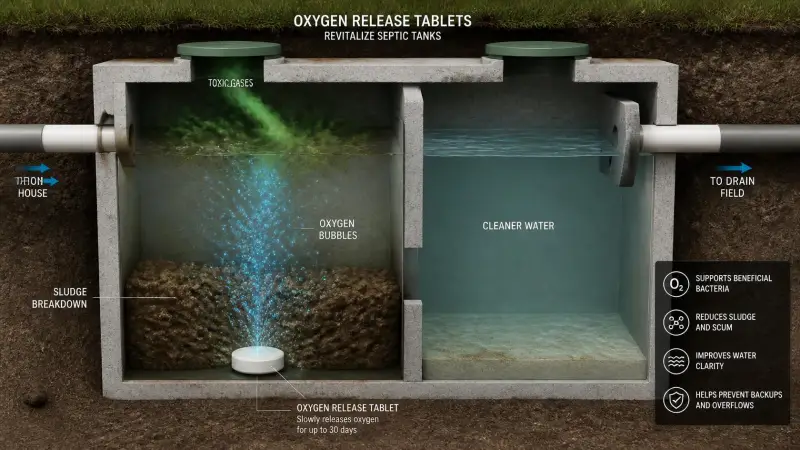
If killing bacteria is the wrong approach, how do you fix the problem? The secret lies in a biological shift: you must convert your tank from a slow, smelly anaerobic environment into a fast, odorless aerobic environment.
Aerobic bacteria are the "good guys" of the waste management world. They require oxygen to survive. When they have oxygen, they consume solid waste and toilet paper up to 20 times faster than anaerobic bacteria. The best part? When aerobic bacteria digest waste, their primary byproducts are simply water and carbon dioxide—meaning absolutely zero rotten egg smell.
The challenge has always been: how do you get oxygen to the bottom of a buried septic tank? Until recently, the only way was to install mechanical aerators, which cost thousands of dollars and require constant electricity.
When evaluating the best septic odor eliminator on the market, you must look past the colorful liquid bottles in the supermarket aisle. Liquid treatments are deeply flawed because they simply wash out of the tank as soon as you run the dishwasher, take a shower, or do laundry. They never reach the dense sludge layer at the bottom where the toxic gases are actually produced.
To truly solve the problem, you need a treatment that meets three critical criteria:
You do not have to live in fear of the next foul breeze in your backyard or a catastrophic plumbing backup in your home. The science of septic management has evolved far beyond expensive pumping trucks and toxic chemical covers.
A revolutionary new product called Septifix has taken the biological science of oxygenation and condensed it into a simple, flushable tablet. By simply dropping a tablet into your toilet once a month, it sinks to the bottom of your tank, releases up to 10 liters of pure oxygen, and unleashes billions of aerobic bacteria.
Within 3 to 5 days, the oxygen violently reacts with the Hydrogen Sulfide, neutralizing the foul odors completely. Simultaneously, the newly introduced aerobic bacteria begin eating away at the thick sludge layer, effectively cleaning your tank from the inside out and saving you thousands of dollars in professional pumping fees.
Restore the health of your home and take back your yard today.